
 #viconsortium
WAPA’s Phase 2 Wärtsilä Generators Could Be Utility’s Latest Costly Mistake, PSC Consultants Warn
Energy utility consultants for the Public Services Commission have labeled the Water and Power Authority’s Phase 2 Wärtsilä generators an “experimental” and an “ill-advised” gamble that has locked the territory into a costly operational trap. During the PSC’s June meeting on Wednesday, part of the discussion focused on the four units which have struggled to operate as initially expected.
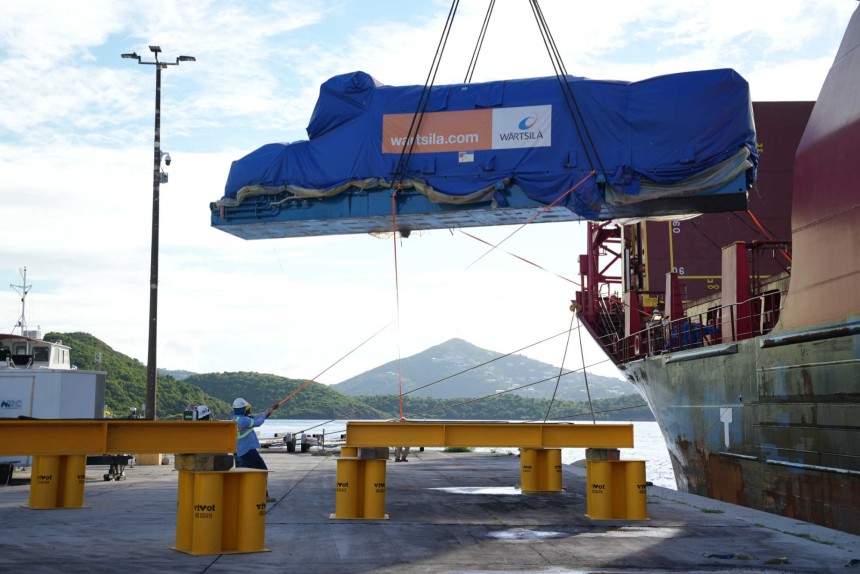
The four generators, purchased in 2020 and installed at the Randolph Harley power plant on St. Thomas five years later, were meant to be operated on either diesel or liquified petroleum gas. “And we can switch that on a dime,” said WAPA CEO Karl Knight during a ribbon-cutting ceremony in January 2025. At the time the contract was inked in July 2020, then-Executive Director Lawrence J. Kupfer noted that the generators purchased by WAPA were “the first engine/hybrid power plant undertaking” by Wärtsilä, and “the first installation of that company’s LG engines which are capable of burning the two fuel types.”
What that designation of “first” really meant is that the units were entirely unproven. PSC Chair David Hughes noted that “they were somewhat experiments, and they’re clearly not working out very well.” Consultant Julius Wright agreed, noting that while Wärtsilä has had experience with dual fuel diesel and LNG engines, these were the first ones to utilize LPG — or propane — as their second fuel type. Courtney Mark, a veteran electrical engineer with almost 40 years of experience at the Trinidad & Tobago Electricity Commission, explained that burning liquid propane introduces entirely different engineering hurdles than burning gaseous methane. “In the case of the Virgin Islands, burning a liquid propane is very, very difficult,” he stated. “The term dual fuel is very familiar to Wärtsilä, but the combination of fuels that are being burnt is very rare.”
So rare, according to Mr. Hughes, that Wärtsilä has “not sold another engine of this type to anybody since.” The PSC chair concluded that “they were probably ill-advised as a purchase by WAPA.” The claims of dual fuel operation made by WAPA officials also do not stand up to scrutiny, Mr. Hughes said. “They are not true traditional dual fuel in the sense that they give us the flexibility to use either of our fuels. They actually lock us into the opposite position, which is we have to have both fuels to run them efficiently.”

Trump Says ICE Will Make Arrests at Airports, Even as Officials Insist...